TECHNONICOL ULTRACEM 2C: Ease of application that matters especially in India
 23.09.2026
One of the main reasons crews delay or try to skip the waterproofing step is the sense that the work is complicated: special materials, strict ratios, expensive equipment, long technological pauses. For the Indian market - where a large share of site work is carried out by local contractors rather than specialised waterproofing crews - this factor matters more than almost anywhere else. TECHNONICOL ULTRACEM 2C is a case where high technical performance doesn't come with a complicated application process attached.
No special equipment needed
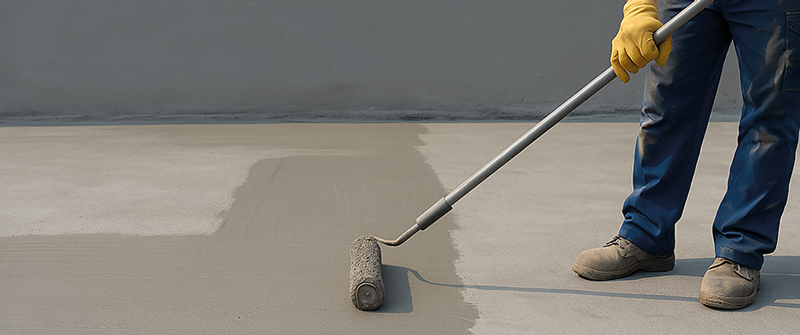
The material is applied with a stiff brush, roller, or trowel - the same toolkit any local crew already carries, from a large developer in Mumbai to an independent contractor in a small town in Gujarat. No compressor for spraying, no special rigging, no operator trained on a specific machine is required. This lowers the barrier to entry: almost any crew can apply TECHNONICOL ULTRACEM 2C, not just a narrow specialist team - a real advantage where finding a dedicated waterproofing specialist in Tier-2 or Tier-3 towns isn't always easy.

A simple process, despite being "Two-Component"
The phrase "two-component system" sometimes sounds intimidating - as if it requires precise dosing, lab scales, and controlled mixing temperatures. In practice, the process comes down to mixing the dry and liquid components into a uniform mass and applying it with ordinary tools.
The pot life of the mixed material is 45 minutes. In hot climates - summer in Rajasthan or Gujarat, for instance, where air temperature easily passes 40°C - this is worth planning around: the mix loses workability faster in direct sun, so it's best mixed in smaller batches and applied in shade or during the cooler morning hours.
Forgiving of an imperfect substrate
On a real job site, the substrate is rarely perfect: shrinkage micro-cracks in the screed, a rough surface straight after casting, joints between precast elements - a typical picture on most sites. TECHNONICOL ULTRACEM 2C is built for exactly these conditions - the product is designed for application on micro-cracked concrete, screeds, plaster, and precast structures, bridging cracks up to 1.5 mm.
Crews don't need to bring the substrate to a perfect finish before applying it - which meaningfully cuts down prep time.

Technological pauses that don't slow the site down
Waterproofing work is often the bottleneck in a construction schedule precisely because of long waits between coats - and during monsoon season, when it's a race against days rather than weeks, that matters even more.
With TECHNONICOL ULTRACEM 2C these pauses are short and predictable:
- a second coat can go on just 4–6 hours after the first;
- the surface is dry to the touch in 6–8 hours;
- full cure takes 7 days - the standard window before tiling.
That means a crew can apply both coats within a single working day and move on to the next stage with almost no downtime on site - especially valuable in March–May, when developers across the country are racing to close out waterproofing before the monsoon arrives.
One system, several types of structures
The same material and the same application method cover a wide range of jobs: terraces, tanks and swimming pools before tiling, balconies, retaining walls, water storage tanks, and protecting concrete from smoke, carbon dioxide, chlorides, and sulphates.
This is especially convenient in India given how common it is to waterproof before laying tiles - on balconies and terraces of residential complexes in Bangalore and Chennai, in bathrooms across mass-housing developments nationwide, it's effectively a mandatory step, not an optional one. Crews don't need to keep different materials on site for different zones - one system covers most of the standard waterproofing details.
Ease of use without a trade-off in strength
Easy application doesn't mean a compromise on performance:
- tensile strength - above 2 MPa;
- elongation - above 50%, so the coating stays elastic rather than rigid;
- adhesion to concrete - above 1.5 MPa;
- resistance to 5 bar hydrostatic pressure (equivalent to roughly a 50 m water column) - a meaningful safety margin for projects in Mumbai, Kerala, and other regions with intense monsoon rainfall and basement flooding.
Safe to apply, safe to live with
The material is non-toxic (per IS 6582), which matters for two reasons: it's comfortable to work with in enclosed, poorly ventilated spaces - bathrooms, service ducts - and once cured, it can be used for potable water tanks without concern for water quality.
That matters especially in regions where reliable water storage isn't a convenience but a necessity - for example, underground and overhead tanks in the drier parts of Rajasthan and Gujarat, where water in a tank needs to stay drinkable for months between rainy seasons.
TECHNONICOL ULTRACEM 2C is a case where ease of application isn't a minor bonus but part of the engineering itself: simple tools, short and predictable technological pauses, tolerance for an imperfect substrate, and versatility across structure types let any crew - from a major developer in a metro city to a local contractor in a small town - close out waterproofing quickly and without special preparation, while still getting a coating built for serious hydrostatic and climatic loads across India.
 Share the article
Popular Articles