Spray polyurethane foam Insulation: One seamless layer for roofs and walls
 27.10.2026
Most insulation fails in the same place: the joints. Gaps between boards, edges around pipes and corners where one material meets another let heat in and moisture through. Spray polyurethane foam (SPF) takes a different approach. It is applied as a liquid, expands on the surface and cures into one continuous layer with no joints at all. Better insulation means the building heats up less under the sun, helping keep interior temperatures steadier through the hottest months.
TECHNONICOL LOGICFOAM SPF is a two-component spray polyurethane foam for roofs, walls and industrial facilities, now available in India.
What is LOGICFOAM SPF?
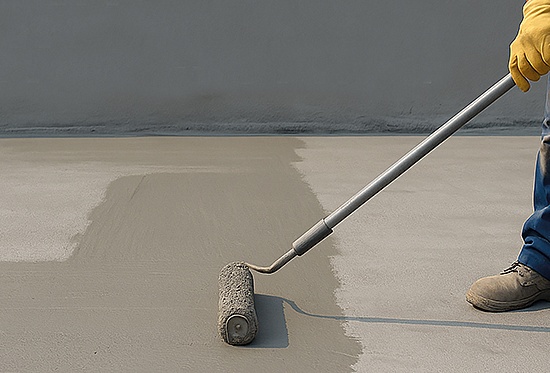
LOGICFOAM SPF is a spray-applied, closed-cell, two-component polyurethane foam. It is free of CFCs and HCFCs. Applied by spray, it forms a continuous, rigid and jointless cover that adheres to the substrate and seals cracks and crevices, making the whole surface moisture-resistant.
It bonds to a wide range of surfaces, including concrete, ceramic, metal, polyurethane foam, wood and acrylic paints. As with any spray system, the condition of the surface should be checked before application.

Why a jointless layer matters
No joints, no thermal bridges. Because the foam is sprayed and expands into place, it follows the shape of the surface, including corners, edges and penetrations that are difficult to insulate with boards.
Moisture resistance. The closed-cell structure (above 96%) and the jointless cover inhibit the ingress of moisture. Water absorption by immersion is below 1.5% after 96 hours.
High insulating capacity. The thermal conductivity of LOGICFOAM SPF is 0.023 W/mK at 25 °C, which allows effective insulation in a thin layer.
Strength for real surfaces. With compressive strength above 300 kPa and tensile strength above 400 kPa (for the 45-50 kg/m³ grade), the layer stays rigid and stable.
Because the foam is sprayed and expands into place, it follows irregular surfaces and seals around pipes, ducts and other penetrations that are difficult to insulate with boards.
Where it is used
- Roofs: spray insulation over concrete or metal roofs, forming a seamless layer that also helps seal the surface.
- Walls: continuous insulation without the gaps that boards leave.
- Industrial and commercial buildings: large surfaces and complex geometry where speed and a seamless layer matter.
For large roofs and walls, spraying a seamless layer in one pass can speed up work compared with fitting and joining individual boards.
Sprayed directly onto an existing surface, it can also be a practical option for upgrading older buildings where replacing the whole roof is not an option.
Why it makes sense for India
India’s buildings face intense solar heat for much of the year, followed by heavy monsoon rain. A roof or wall that insulates well and resists moisture helps keep interiors more comfortable and protects the structure behind it. A continuous, jointless layer is a sensible fit for both requirements.
Frequently asked questions
Is LOGICFOAM SPF suitable for roofs and walls?
Yes. It is designed for a wide range of insulation applications in buildings, including roofs and walls.
What surfaces does it bond to?
Concrete, ceramic, metal, polyurethane foam, wood and acrylic paints, subject to a check of the surface condition.
Is it environmentally responsible?
LOGICFOAM SPF is free of CFCs and HCFCs.

Talk to us
Planning insulation for a roof, a wall or an industrial building?
The TECHNONICOL India team can help you choose the right system. Download the technical data sheet or message us on WhatsApp: +91 74497 44950.
 Share the article
Popular Articles